Tuesday, 3 August 2021

2021 Garlic Season


We still have some Silver Skin garlic to harvest, but thanks to our family team effort, almost all of it is in the barn drying, some is trimmed, and the bulbs look pretty nice! There is more purple colouring on some of the Porcelains than is usual, though I have seen it before...maybe the dry heat of spring brought it on.

 If you want to be added to our mailing list, please send an email to goldenacresfarm@hotmail.com. 

Orders can be picked up at the farm, as usual. (2579 Line 47, RR1 Gads Hill, Ontario.) First two weeks of September or by appointment.  We can accommodate contactless pick up, if you request it. 

You will be able to call or text your order to 519-588-5290 (Julie's Cell) or email to goldenacresfarm@hotmail.com. On or after August 20th, please. I usually release the Catalogue on August 15th, but as that lands on a Sunday, I've decided to give myself a bit more time to get inventory prepared and garlic trimmed. Because we cure the garlic the old way, leaving the stalks on, it takes longer for it to dry.

Remember, we do not process credit cards. Email transfer is set up for automatic deposit this year, when you send it to julie.goldenacres@gmail.com. Also, cheques, money orders or cash are good methods of payment. 

I want to take a moment to be grateful for all the wonderful people that I have met over the years through doing garlic. The Stratford Garlic Festival was a great place to meet every year, and I'll always be thankful of the friendly Kiwanis volunteers who made our twelve years there not only possible, they also just had your back, come rain, storm or technical failure. Those years were special!


My sister Rachel, with our friend Dennis, who makes beautiful wooden boxes to raise awareness of the Stratford Perth County Community Foundation, a charitable foundation that provides support for our local community. 


Thanks Dennis, those boxes are a good way to showcase our onions! (Also in the picture is the Dakota Black Popcorn I grow, and our butternut squash, of course.)


Sunday, 11 July 2021

Brix testing of Garlic Scapes

 Most of the time, when people talk Brix in Garlic, they mean the clove juice, and a good rating is about 40, and the higher the better. The refractometer I have to use doesn't go that high, however, (I tried it by squishing the juice out of a rocambole clove once, and the line went all the way to the top, maxing it out). I looked for a way to get around that problem, and still use a field crop refractometer, so that I could still get in on the action with all my different varieties and strains of garlic. (A good refractometer costs $200, so far as I'm aware.)

If you've ever scaped a large plot of garlic, you'll know about that sap that drips like crazy out of the cut ends of a scape, and dries white and slightly crusty/itchy. It ruins running shoes and if you don't wash your scaping clothes right away, the smell can linger for weeks. Normally when you use a refractometer for field crops, you have to squish the leaves of soybeans and clover really hard to eek out a drop or two of juice so that you can test it. This scape juice pouring out just seems too easy, and you have to cut them off anyway! But why not, lets test the scape juice. I've done so for four years, on many different varieties to try and establish a baseline, or at least a range of what might be typical for garlic scape juice, and here are my results: Garlic Scape Brix testing at Golden Acres Farm 

Friday, 29 January 2021

For the Love of Earth

 Hello there friends and philosophers,

I have been struggling to figure out what to post, as information seems to be coming at us so fast these days, and everyone has a different opinion about what they hear. I have a lot of different opinions about what I hear too, and finally, it occured to me that by not sharing, I'm effectively censoring myself.  Besides, opinions are meant to be simply a waymarker on the path we are taking, just like footprints, so I'll take step here, and you can decide if you like the boots I'm wearing, or the earth upon which I trod.

Yesterday was the Bell let's talk mental health day, and some of the things I was listening to reminded me that the surest way to support your mental health is to have meaningful work.  I take issue with anyone who arbitrarily divides certain classes of work into essential, and non-essential - what is essential for the body is not the whole of what is essential for the mind or spirit, and denying the importance of some kinds of work is just another way of negating someones life experience, which can have disastrous consequences.  It is important for everyone to decide for themselves what "essential" means to them.

My mother's maternal family grew and marketed vegetables in southern Pennsylvania. I guess you could say they were one of the "lucky" families that made it through the depression with food on the table and a secure place to live, because of their rather default lifestyle. When my grandmother married, and moved to Ontario, she continued to grow a large household garden - not because she was afraid of food shortages - but because it was the only rational way to do it, if you wanted to can and freeze enough to feed your family through the winter. She was ever so relieved when Green Giant figured out how to mechanically process frozen peas that didnt taste like starchy cow fodder. Though they were never as good as garden peas, hand shelled and picked at peak sweetness and tenderness, frozen peas from the grocery store were a reasonable compromise that liberated a lot of time and effort. For reasons of her own, my mother went back to that tradition of shelling and freezing garden peas...its not logical or even "essential" perhaps - modern canning factories can do it more efficiently - but it feeds a part of her soul, and,  in having taught it to her daughters, she keeps a kind of experiential knowledge alive, that has value to us as a family.

Coming into this financial catastrophe that, despite popular belief, is not sitting on our doorstep - it's been an unacknowledged house guest for years - I find that I am taking for granted the enormous wealth creation that has been in my hands, all these years, simply by growing my own food. I'm glad for opportunity to finally understand the value of what I have.

Every time an item is sold, and transferred from maker, to marketer to retailer, to consumer, not only does the government usually take a cut (sales tax) but the initial price that the maker receives becomes a smaller portion of the final cost of the goods. It's almost like inflation, but in real time, on real goods. Each middleman performs a service that is essential to the process of getting that product to the buyer, including advertisers...but what if you didnt have to get it to the buyer? What if some things you could make for yourself?

This is the flip side of consumer economics - saver economics. It hasn't been popular in part because of interest rates being so low for the past two decades. When my parents were first married, it was possible to live off of the interest your savings made for you. Taking out a loan was serious business, and you paid dearly for the time it took for you to pay the money back, and become self sufficient again. Money and time are linked by interest rates. Ironically, at a time when minimum wage is the highest it's ever been, the value of our time, as defined by interest rates, is at its lowest. When your debt doesn't grow, but your pay check does, it sort of looks like a good time to take out a loan; a blank cheque on life, as it were, no matter how artificial the circumstances.

I would not be surprised if the Bank of Canada is now getting close to implementing negative interest rates, as the European central banks have been doing since 2016. Negative interest rates take ownership and savings and make them out to be a liability. Add inflation and you dont need highway robbery to bankrupt people.  

Our essential tools need to be justice, not welfare. Justice slices away untruths and inequalities that otherwise make it impossible to protect an individual's right to properties, or to work for their own benefit. Welfare is a moral sanction that justifies our  tolerance for inequality. 

 It is unethical to take more than you have to give - moreover, it is unsustainable to life on earth - yet that is the financial leadership of first world countries, who would have you believe that deficit is the inevitable truth of humanity's productivity. Think about it: if you agree that the debt our country is carrying is a natural consequence of the most evolved economic system we could possibly facilitate, it means that human beings are parasites, incapable of supplying to their own needs. 

This is grossly untrue. 

I know this from experience because I know what productivity looks like before it becomes drained by the system. I grow my own food. I trade for some things, and I support small business, which is the ethical form of capitalism, and the backbone of democracy. 

  The future will never look exactly like the past, yet the past holds a mirror to our future that defines how far we have come, and in what direction.  

So where are we going, and what will life on earth look like in the future? Well, it's up to all of us to ask this question: Do you smell life in back door deals behind corporate counters, or in back yard gardens, under rotting leaf mulch?  Can you feel it growing abundantly in nurtured soils, or in dirivitive market shares? Can you taste it in nutritious, homegrown vegetables, or in lysol cans? Where do you see life?  

Julie Fleischauer

Thursday, 6 August 2020

2020 Garlic Season

Hello Garlic Growers and Enthusiasts,
Our 2020 Garlic Catalogue has been out since August 15th, We are sold out of everything but a few bulbils packets, as of October 2nd. It has been a wonderful garlic season. Thank you to those who placed orders and dropped in at the farm!
  If you haven't already, you can email me to get on the mailing list : Julie Fleischauer goldenacresfarm@hotmail.com or julie.goldenacres@gmail.com
 Our catalogue is posted under the "2020 Catalogue" page. With a short list of what is still available (everything else is sold out). (If you can't find the page and you are using a mobile device, you may have to switch to "view web version")
 This year, we have just been doing pick up orders and shipping, as the Stratford Garlic Festival was our only other venue. Golden Acres Farm is now open by appointment only. 

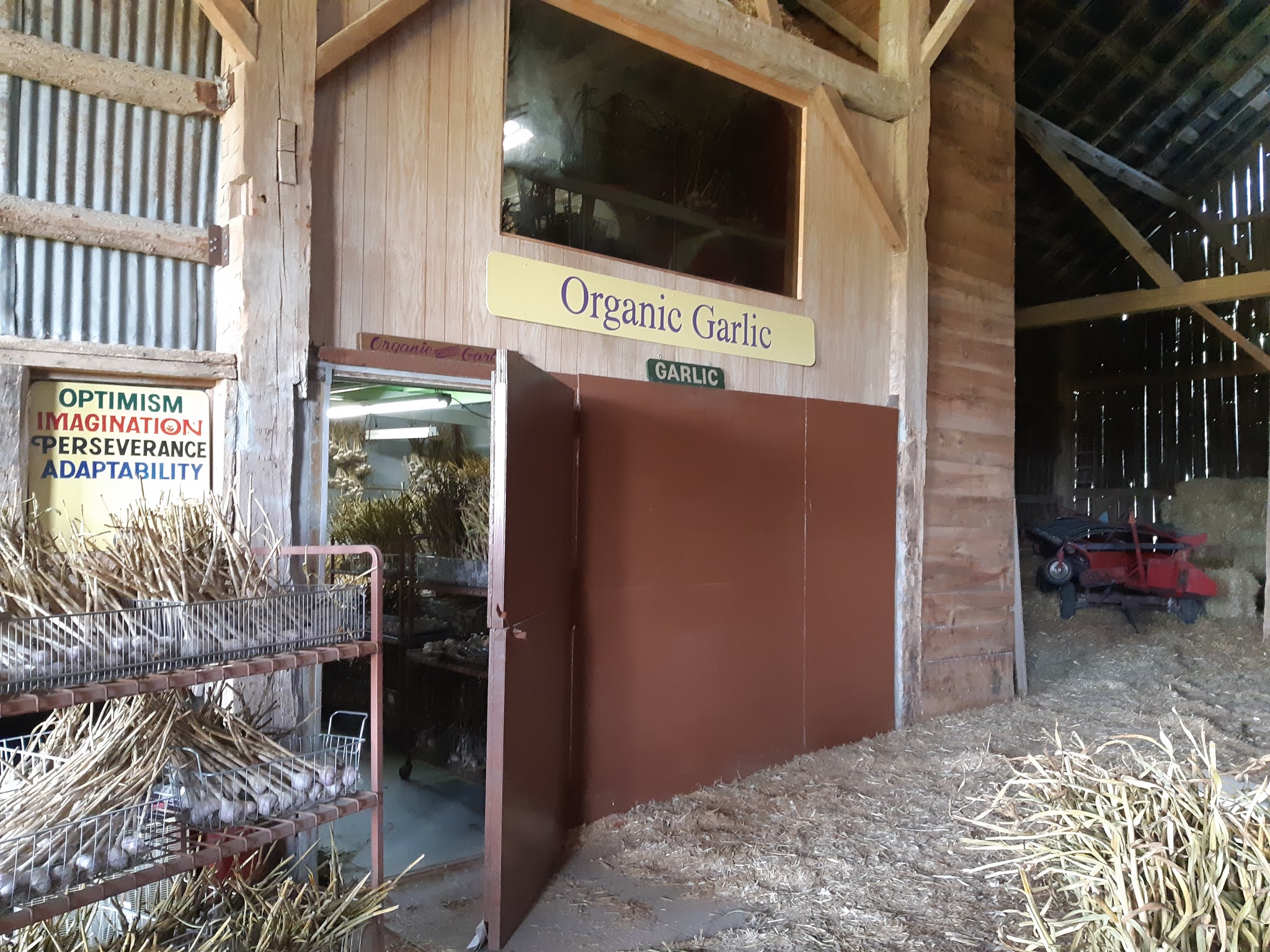
  If you require, we can provide contact-less pick up for your order. Regular pick-up location is around to the back of the barn, inside the large sliding doors where our drying/storage room is, in the repurposed granary room. If you have picked up garlic in the last couple years, you will know where I mean:
  Contact-less pick up will be inside the small door at the front of the barn:


 Please take note that we do not process credit cards, so please bring cash or a cheque, or prepay by email transfer. Prices this year are $18.00/pound, $9.00/ half pound, and $4.00 / bulb. There will be some 3 lb, 5 lb, and 10 lb limits on the bulk strains this year, and some of the strains will be available  only by the 1/2 pound or by the bulb. This is to encourage small gardeners, and to hopefully make more selection available to everyone. 

We've got some Silver Skins coming out of the ground today, that look fairly promising, so they will be available on the catalogue, sold by the bulb.  The Silver Skins and Creoles were planted this spring. I'm finding Spring planting just for those two kinds is often better than fall planting. I am not offering any spring shipping however, so if you want to try spring planting them, you'll have to store and cold treat them yourself. They keep really well, and cold treatment consists of putting them in the garage, or a cold space, for about a month before planting (just be careful not to freeze the bulbs in minus Celsius conditions).  Otherwise, they can be planted in the fall, with all the other kinds. I suspect that they do better in a protected area anyway, rather than the wide open field where I plant them. 

In general, the garlic did really well this year. I hope that if you've grown garlic, you've had similar success.

 Garlicky Regards, Julie

Sunday, 7 June 2020

Stratford Garlic Festival Cancelled for 2020

Vendors got the notice that the Kiwanis Club of Stratford has made the difficult decision to cancel the Garlic Festival this year.
I discovered that it may have been advertised in some media as an up-and-coming event. It was intended to continue this year; however, the ongoing social distancing rules proved too much for the organizers to humanly navigate. It takes an atomic clock to keep up with the news these days. So to clear up confusion wherever possible, I thought I'd put up a notice on my blog.

I expect we will be doing more online sales this year, through the Catalogue that I e-mail to you in August, if you've signed up or asked to be on the mailing list. I also post the Catalogue on this blog in August, under it's own page.

I very much invite customers to pick up their orders at our farm! I am positive we can come up with a comfortable solution for picking up orders in September.

 The half-acre of garlic in our field is looking pretty good so far. Only three leek moths were caught in the traps so far this season, so it looks like the pressure from those pests will be minimal. I'm looking forward to a good harvest!
All the best to you,
Julie

Saturday, 2 May 2020

The Beautiful Colour Green


 I love this time of year - when you see something green and gloriously growing, it's such a fresh new sight that you might actually take the time to marvel at it, and give it the attention that it deserves.
 The garlic of course has been up for a while, but it's finally attaining a handsome green, whereas it looked a little frosted and uncertain before. There is a really good stand this year!- I don't know how other growers made out with winterkill this year, but it's virtually non-existent here.
  I've had a few more questions than usual about spring garlic seed this spring, so I thought it'd be fun to show the difference of Spring, versus fall planted garlic:

On the left is Red Russian (a Marbled Purple Stripe) and the rest of the fall planted main crop. Center is Ail Rose de Lautrec ( a Creole) And to the right is Aglio Rosso (also Creole). Both Creoles were put in our vegetable cold storage in mid February, then planted one of the first days of April. 
This is not a perfect comparison - they are different varieties, and the Creoles were significantly smaller in bulb and clove size than the Marbled Purple Stripes to start. But, it gives you an idea of the advantages of planting in the fall.
  And, just to clarify, I don't sell Spring garlic seed. Bulbils and Creole and Silverskins are the only kinds of garlic I recommend planting in spring. The creoles and Silverskins seem to do better because their tender constitutions do not have to bear the brunt of our cold winters, whereas other, "more native" varieties of garlic, thrive in our wintry latitude. Bulbils do well either fall or spring planted, or so I've found. I wish I could plant Turbans in the spring, but keeping them dormant and in good quality is really not that easy. It's the quickest growing - fastest spoiling of any garlic. It's always sprouting by the new year. Not something you want to take a chance on for spring planting, especially since a seed slowly uses up it's energy reserves, and has less vigour in the spring. The effect is mitigated in Creoles and silverskins, because they keep the best. In the words of Bob Wildfong, Director of Seeds of Diversity Canada, "a seed is a baby plant, it needs food." When it's stored correctly, it uses up less food,but it still needs something. A dormant seed uses the food stored in it's body, which is why old seed sprouts and often grows slower, if it sprouts at all. Sometimes seeds die. (I'm talking about garden seeds now, lettuce, kale, peas, and whatever other kind of seed you can think of.) Fresh seed is always ideal.

I'm excited to see what kind of innovation will appear in gardening techniques this year. I never used to think wecould grow basil on our clay-loam soil here, but it turns out we can, if we hill it up and mix compost and a bit of sand in the soil directly around and under the basil plug. A lot is possible these days that once wasn't. We have a lot more tools,and ideas about how to use those tools. I haven't heard about a run on chicken wire and pest protection yet, but I'm sure it will hit in due course. There's a sort of irony in that farmers have felt criticized for years about how we deal with small, furry opportunists. And they say there is more wildlife in the city than there is in the country, (population by square meters, I'm thinking, which would make sense, since the  same is true of the number of people in a city).  I guess I will find out, with my city garden this year. The house I bought in Stratford was built in 1899. It's amazing to think how people lived 120 years ago. I have such gratitude for the foundation of knowledge they have built for us to stand on.
  Julie


Sunday, 22 September 2019

Hi There,
We've got pretty much all of our garlic planting done for the fall. 20 rows (30 inches apart) and  350 feet long, for a 0.4 acre next year! We score rows and then hill them up with a tractor, aiming to get the cloves about three inches deep. I love planting in a T-shirt in the sun - the garlic likes it too, if the last 13 years of growing garlic has shown anything. Right around the Autumn Equinox always seems to be our planting time - our clay-loam soil is dry enough to work with.

I wish you guys all the best with your planting! - whenever you plan on getting it done.
I always figure Sept 20 - October 10th is about right, but you've got to do what works for you.

Also, a little note: We are sold out of seed garlic for the season. I have some garlic bulbils available yet, but that's about it. Just a small amount of eating garlic is available from the farm. We don't have store hours, but are usually home, or you can make an appointment.


The John Deere 40 is ready to hill up the garlic row. The rows to the left of the basket have been hilled up aready. It helps with spring and winter flooding to have the soil raised over the garlic row - it keeps the ice from forming a solid sheet and blocking the air from getting at the soil. It also adds depth to the top soil, which is never a bad thing, and sheds excess rain off of the row all through the growing season.

Wednesday, 17 July 2019

Sizing it up Before Harvest

So, this is a question I ask myself every year:
Is this variety of garlic ready to be dug?
 I ask myself this roughly one-hundred times in the last weeks of July, and all the way into August, as I have quite a few varieties. After twelve years of growing garlic to sell, I still get nervous about when to dig.
It's a ticklish thing, you want the bulb to be nice and mature, but you want it to also have keeping quality and nice layers of wrappers so that it is salable and pretty.
The fail-safe way is to count the leaves, I think. Most bulbs will have six to eight leaves, and if about three of the bottom leaves are drying down, you can be sure it's not just a drought causing that - it's ready!
40-50% of those bottom leaves, dry or yellow, that's the clue.
If you look at the whole plant, it should be more green than yellow, because the dry leaves get smaller in appearance.

Sometimes within the row there will be some variation of when the plants are ready, even if it's the same variety, (In my case, out in the field with 400 foot long row, that variance can sometimes be caused by tile drainage, as in, where the soil was nice and the garlic did better, and so is larger, greener and later) but the variance should be pretty minimal. If a few odd plants are yellow, and the rest looks green, well, that could be diseased plants that are suffering, so don't go digging up the whole row thinking they must be ready, in that case.
Always be gentle with the bulbs. They bruise if handled roughly. It may not show up right away, but cloves that are damaged might mold or dry up later.
For Pictures and a more detailed explanation of how and when to dig, as well as some calendar dates to shoot for, see the blog archive 2015  "Harvesting Garlic" July 11.

You can usually tell early on how big the harvested bulb will be, based on how thick, or big around the neck of the plant is. Although, a few varieties have odd bulb - to - plant size ratios and can have really thick necks, with puny bulbs, or vice versa. Purple Stripes come to mind, they can have large plants with smallish bulbs. Turbans on the other hand can have respectively large bulbs compared to how thin and tiny the plant looks.)
Turbans seem to keep better if they are harvested early - as in, when only one to two leaves are dry.
In some kinds of soils the wrappers of Turbans and Asiatics will also split if left in the ground as long as other garlic, so be mindful of that.
And where you put them to dry does have some importance as well. Keep them out of direct sun - that can cause the cloves - which are actually "storage leaves", to turn green, same as an onion or potato might,( they are blanched by being under ground while growing, so they are white/cream coloured and need to stay that way). Indirect or artificial lighting is fine. Direct sunlight can also "cook" them, and excessively high temperatures can also cause the cloves to deteriorate (Something called Waxy Breakdown) so try to avoid places that lock hot air into the drying area when you are choosing a spot for drying your garlic. A box fan or oscillating fan and an intake/out take are all that's needed to keep air moving in the drying shed.
I always recommend the slow way of drying garlic - with the whole stalk attached until it is cured and dry. Any home gardener can do this method, it's easy to make bundles of 8 -10 bulbs and hang them somewhere, or lay them out on racks or in open baskets. It takes about two and a half to three weeks, depending on the size of the garlic and how dry the air is, and you have a better product from it.
The flavour of fresh dug garlic is hot, juicy and simple, so it is best to wait until the whole plant is dried down anyway. Garlic tastes the best about two months after it's dug - it reaches a maturity of flavour that brings out depth and character, and then it begins to very slowly decline into the winter months, eventually tasting simple and firey again, but dry, instead of juicy.

Well, I must go out and check on a few of the early varieties again, even a day or two can make a difference in how they look. I've dug a few Turbans already, but nothing else, so I'm wondering if the harvest will be a bit late this year.

All the best with your harvest! I hope it's a good one! Julie


Sunday, 30 June 2019

Scape Season - A little late, but not unusually so

It is soon time to cut your garlic scapes, if you haven't done so already. I've been getting a few emails of people wondering if their scapes should be out by now, or if they are unusually late. By now, yes, they should be out and starting to droop into their first coil, (unless you have a softneck variety which doesn't normally produce scapes). And yes, this year the scapes in my area are late. My Porcelains are finally starting to make a soft coil.

  If you also experienced a cold wet spring in your area, then things were probably slow to get going. Garlic Harvest can be as much as about two weeks later on a wet cool year, or two weeks earlier on a hot dry year, that's just how it is. Scapes seem to track the daylight patterns better (Summer Soltice being the initiation of the scape production in the plant), but they can still be a week or so later or sooner than usual.
For Porcelain type Garlic, July 6th is my benchmark for cutting scapes - note that that is for getting rid of the scape, not for eating it, as I let my scapes get a bit woody and stiff when the main focus is for bulb quality.
It looks to me like July 6th will be a good time for me to cut my eating scapes this year, so we could be about a week late...[Correction as of July 4th, Turns out scapes really do come at about the same time every year, all this heat maybe sped them up, I'm going say they are just a couple days late this year. My Porcelain scapes are ready to eat now, and a few are a tad over mature. LOL, maybe they were late to show up, but they made up for it once they got going.]

One of my favourite things to do with scapes is to use them in a beautiful Korean recipe for fermented scape sauce. As with most beautiful things, it's really simple:
2 parts Soy Sauce (no wheat soy sauce if it needs to be gluten free)
2 parts vinegar (pickling strength 5%)
1 part sugar
Fresh Garlic Scapes
Combine the first three ingredients in a sauce pan and bring to a boil. Cool.
Meanwhile, cut flower end off of the garlic scapes and chop into fine pieces (you can cut into 2 inch lengths and feed into a food processor if you like, otherwise 1/8 inch (or 3 mm) pieces).
Pack scapes into large, clean, (preferably sterile) jars. You need to make enough of the soy sauce mixture to cover however many jars you want to make.
Cap the jars loosely and let sit for 1 week, at room temp.
Strain juice off. Boil juice, cool and add back to jars.
This sauce can be consumed fresh, from the fridge for a couple weeks.
  Or, you can follow this next step for preserved sauce, and enjoy all year round (they make great gifts, then you can woo even the garlic critics and get them addicted to garlic too! Make sure you make enough to last until the next garlic scape harvest!) :
After the one week fermentation period, Empty the jars into a sauce pan or stock pot, and boil down, until the sauce begins to thicken a little.
Pack hot into sterile canning jars: like you would do with jam, leave a 1/8 inch space at the top, below the lid, and fingertip tighten the canning lids. Set jars to cool with a dish towel laid over them to prevent drafts from creating a premature seal. Make sure all jars are sealed before storing.
This stuff makes excellent sauce to use on roast meat, sandwiches, with grilling, etc.

Garlicky Regards, Julie


Saturday, 22 September 2018

Planting in the Fall

Hi There! ;-) Thanks to someone's comment, I realized I've never actually wrote about planting garlic in the fall - A serious deficiency, as that is typically the best time to plant!
Right now I am quite busy, in the midst of planting, so I'll draw the outline and fill in more detail later:
First: Acquire good seed. Nice sized bulbs, undamaged and free of mold, from a local source. (Hardneck garlic is typically Ontario, or at least Canadian, so if it has a good strong stem in the middle that's one indication.)
Prepare your soil for planting (it generally doesn't need any special fertilizers unless you are concerned about the soil being poor quality just get it tilled and ready). Sun, or part sun seem to be ideal, although I've suspected that garlic can grow pretty good with part shade too.
Break the cloves apart - each one becomes a new plant. Plant them 3-4 inches deep, with the pointy end up - that's where the sprout emerges. Recommended distance for small spaces: 8 inches apart in a grid. Or, 6 inches apart in rows, 20 - 30 inches apart. I find hilling up the rows, or raising the bed a good idea for drainage and winter run off.

When to plant: I do it right now: Sept 20 - 25. Most people say that's too early. For me it works.
You can plant into October. I find November is a poor time to plant. Especially if we have a early winter, the roots don't have enough time to establish, and the bulbs can be small at harvest.

For keeping track of different varieties, a map kept in a safe place is the best insurance. Stakes can fall out or go missing or loose their marking over winter - use them anyway, but keep a map!
I do both, plus I grow very different kinds next to each other in the row, so that if the stake goes missing, I can still tell visually where the variety changed (a bio-marker, if you will).

If your garlic comes up before the snow flies - don't worry, I've had that happen quite a few years, and never had problems with the next harvest. If it doesn't come up, in the fall, and you are worried about the germ of the seed, you can always dig, very gently with your fingers and check on them (don't break off the shoot if it's there!) Otherwise, have patience, garlic is a survivor and you will find out in spring. Garlic emerges quite early, and grows quickly in spring.

Mulch is an option as well - both for winter protection and summer moisture conservation. I've used straw, hay and fall maple leaves to good effect. Just be sure the spout can get through the layer of mulch in April/May.
If you have rodent issues, apply the mulch after they are done making their nests - after freeze off in the late fall.

...I hope I didn't miss anything. It's back to planting for me!
All the best with your planting projects! Julie


Saturday, 15 September 2018

Thanks for making the Stratford Garlic Festival Great!

Hi there! We had a wonderful two days at the Stratford Garlic Festival last Saturday and Sunday. It is always great to talk to everyone and meet new people.
If anyone wants to be on our mailing list for next year, just send us an email with the subject as "Send me a catalogue next year!" Thanks.
A couple of our garlic strains sold out at the Festival, but there are still quite a few Porcelains and Marbled Purple Stripes in stock. And some Rocamboles and Creoles.  Please inquire if you are still looking for seed.

And, something I've been wanting to share: if any of you struggle with the tedium of peeling garlic, especially for a large event, like pickling garlic, preparing garlic for dehydrating, or roasting a forty-clove chicken! (A good meal choice to plan in after garlic planting, lol.) There is a simple trick that can make it easier to get, especially that thin sticky membrane off the cloves. Break the cloves apart, and JUST PUT THEM IN WATER! Tepid water works fine, soak for about five to ten minutes. the water loosens the clove skins and keeps them from breaking, so that once you get your paring knife under them, they come off all in one piece. This saves you time, no matter how much garlic you eat for lunch! And no gadget required.
Garlicky Regards, Julie

Monday, 27 August 2018

Stratford Garlic Festival Coming soon!

Less than two weeks until the Stratford Kiwanis Garlic Festival! We are getting our garlic, garlic bundles, potatoes, onions, and art ready to share with you. Hope to see you there!
Also note that if you can't make it to the Festival, and you want to place an order with us from the catalogue, we will be taking orders up until Thursday Sept 6th, and then starting again on Monday, Sept 10th. Any orders placed later than the 6th will be replied to on the 10th. Selection goes down after the Festival, so please try to order on or before Sept 6th. Thanks!

Sunday, 15 July 2018

Garlic Harvest has Begun

Our new Seed Garlic Catalogue will be out in one month! (August 15th) 
I'll have it posted in the "Catalogue" page, replacing last year's list. 
 I expect we will have a very good harvest of Porcelains and Marbled Purple Stripes. All the other varieties look okay. This hot, dry weather has had an impact on the garlic, but all in all, it looks like a good year!

Just a note about harvest time: it probably will be a bit earlier than normal, but still make sure when you go to check on the plants that they are properly drying down from the bottom leaves, and not just from the leaf tips. It looks like they are drier than they really are in this weather, and it doesn't do to pull the bulbs out before the cloves are fully filled out. On the other extreme, don't dig them when the whole plant is crispy and dead - those leaves are wrappers covering the bulb! The bulb needs about three wrappers for good keeping, so at least three green(ish) leave are a must.
  I've dug all my Turbans, and am in the midst of digging the Asiatics, Artichokes, and some the small-bulbed Creoles, as well as a few Rocamboles.

If you happen to come out to the farm this fall to pick up a garlic order, be sure to look up at our barn roof. Last summer my Mother, Dianne (a sign painter from the pre-vinyl diecut days of hand lettering) went up there to paint this mural for us to enjoy as we work out in the garden.


You can see it from the road for a little bit, in between the trees, as you approach our farm from the East (if you are coming from Kitchener-Waterloo, say). 
In June I got a close up of it with a rare, dawn rainbow:


Thursday, 1 February 2018

A Great Breakfast Idea

A friend tried this interesting combination while feeling the incoming effects of the flu.
It's really good, actually, and very healthy, too!

  • Garlic, for anti-viral and immune boost.
  • Honey, being anti-inflammatory and healing.
  • Cinnamon, as a circulation stimulant.

I recommend it for any special breakfast or afternoon treat. Super simple to make.
Start with a fresh, hot slice of buttered toast.
Slather on some honey (garlic honey is pictured here, but that's not a necessary, since our next ingredient is fresh, crushed garlic). I advise spreading the honey first, so that your knife doesn't inoculate the honey pot with garlic flavour. Then, squeeze a fresh garlic clove through your favourite garlic press and spread that evenly over the honey and buttered toast. I suggest a nice flavourful Rocambole variety for early in the flu season. A small clove of Porcelain garlic works too. And for this time of year: whatever you have left in storage that hasn't been eaten already!
Top this off with a dash of Cinnamon.
And that's all!
Bon Appetit!

Saturday, 2 September 2017

A Video with the Stratford Garlic Festival

This Summer the Stratford Kiwanis Garlic Festival was looking for Vendors to participate in creating a short promotional video for the Festival. It was great fun to have Elizabeth Kerr and Scott Wishart come out to the Farm to shoot this little film, I hope you enjoy watching it.

https://www.youtube.com/watch?v=nB87ew1IF5Q

It features myself and the garlic in our 2017, 1/2 acre plot.
You can also see the bulbil plants that I grew this year as part of an on-going seed renewal, and a small part of where we dry the garlic and store the garlic, inside a re-purposed granary in our 1911 bank barn.  -  Julie

Tuesday, 15 August 2017

Garlic and It's Many Flavours

  I've been thinking about this story lately, and just wanted to share it:

  My older sister Sheri, who used to partner with me in growing the garlic, was going on a trip over to Germany with her boyfriend last November, to visit his family there. As they were weighing their backpacks for the airport, I went and got a couple jars of the garlic powder that I make. Not being able to travel with them, I wanted to at least be a small part of their trip, in the gifts they could share with the people they met.

  Thousands of years ago, travelers would carry garlic bulbs in their packs and trade them up and down the silk road, spreading new varieties of garlic throughout Europe. Following this tradition, but also respecting Airport security, a couple jars of my dried powder got nestled safely into Sheri's pack.

  After Germany, my sister and her boyfriend Tobias, toured eleven other countries in Europe, and at the end of their trip, flew out to the Spanish Island of Mallorca, where the sub-tropical climate had everything lush and green, with olives and oranges growing even at the start of January.

  One of the places they visited there was the home of a farmer and garlic grower. With her last bottle of garlic powder, Sheri traded some goodwill. She told me later that this fellow was fervently happy to receive, "Canadian Garlic!" He lifted the lid to gasp in delight at the sharp smell of it. Canadian garlic, he said, is so much stronger and more flavourful than what he can grow in Mallorca. He was a BC resident of Grand Forks, before moving to Mallorca, and missed the taste of home.

  Making this kind of connection with someone like that, I felt, was the best part of their trip, though Sheri raised a bemused eyebrow at me when I told her so. Sheri couldn't tell me what variety Sky was growing in Mallorca, but I can imagine that whatever kind it was, it just didn't get the right winter dormancy and probably had a whole different soil composition effecting the flavour.

  In Canada we grow many varieties that are both strong and flavourful, including Porcelain types, Purple Stripes and Rocamboles. Our cold winters and warm summers, and good soils make up for the rest of it.
  In Cuba, I've heard, it is hard for farmers to grow garlic bulbs much bigger than a golf ball, though the tiny cloves are greatly priced by the locals. They owe this mostly to their lack of winter weather, or so I'm led to believe.
  Personally, I have always been a little jealous of Spain and France, for that area of mainland Europe can grow massive bulbs of Creole garlic. I have been in love with creole garlic ever since I've read Filaree Farm's description of that variety in their catalogue. Now that I have acquired twelve creole strains to grow myself, I've nick-named them "pearls of the earth"; because they are special, with their pearly sheen and long keeping abilities; but also because they are quite small in size.
  There are other varieties that I grow in Ontario, without much success, that grow really well in other parts of the world. So isn't garlic fantastic! It has travelled with people almost everywhere they have gone on the globe, and as a species, calls many many places home.

  So what makes garlic flavourful?

  Well, sulphur is one of the most important elements of flavour in garlic (and other alliums). We see this most clearly in the story of Vidalia onions, those large, sweet baseballs that are only available in season. True Vidalias are grown in Vidalia, Georgia, where the low sulphur content of the soil accounts for the mild flavour of the variety. The sweetness, really, is there all along, Vidalias may have more of it than most kinds, but all garlic and onions have a high content of sugars in their bulbs, to help with freezing and over wintering, you just can't taste it because of the heat that so often accompanies and overpowers that sweetness. Notice too, that Vidalia oinions, and most other sweet varieties of onion, do not keep as well as cooking onions. This is also an effect of sulphur. Low sulphur content in the onion bulb, or garlic clove, can be a major contributing factor to poor storage quality.
  Elemental Sulphur requires biological soil life to convert it into a sulphate before it can be used by plants. I work with a crop and livestock consultant, who told me that other consultants in the States recommend almost twice the amount of sulphur be put on the fields as a mineral amendment, than what he would suggest for Ontario. The reason being that in southern climates, the soil life is active for a longer period of time than it is for us in Canada. The soil life uses that much more sulphur (and other minerals) for every growing season, as well as possibly getting more soil leaching from high rainfall. I imagine that if sulphur is not a priority in the fertilizer, one could get sulphur deficient soils much more easily in sub-tropical climates, and consequently, produce a milder, sometimes poorly flavoured garlic.

  It is not just sulphur though. Garlic, with it's high sugar content, and coarse root structure, relies quite heavily on soil life to make nutrients available to the growing plant. It needs certain things like Phosphorus, for energy and boron for making sugar, and the whole plethora of trace minerals to give it depth of flavour and keeping quality. Flavour is one of the most complex aspects of plant genetics, and no one has quite figured it out, but we do have a starting point.

  For an experiment I tested some garlic leaves for a few basic minerals last year. One batch was from heathy plants, and one from plants that were not doing so well, and were going to be culled soon. Here were the results:


Heathy Plants:                                              Unhealthy Plants:
80.2 % Moisture                                           81.0% Moisture  
19.8 % Dry Matter                                       19.0% Dry Matter
On a Dry Basis:                                             On a Dry Basis:
1.78% Calcium                                             2.25% Calcium

0.44% Phosphorus                                        0.32% Phosphorus

0.33% Magnesium                                        0.23% Magnesium

1.09% Potassium                                          1.37% Potassium

0.01% Sodium                                              0.01% Sodium

0.32% Sulfur                                                0.29% Sulfur

31 ppm Iron                                                  38 ppm Iron                                            

32 ppm Zinc                                                  23 ppm Zinc

10 ppm Copper                                              8 ppm Copper

15 ppm Manganese                                       13 ppm Manganese

4 ppm Molybdenum                                       2 ppm Molybdenum


  Samples were taken of the top leaf of numerous plants, cut and tested in mid June. As you can see, Calcium and Potassium are higher on the Unhealthy test, but almost all the of the other minerals are lower. It actually has a less balanced mineral profile, which may be a big part of flavour as well.

Sunday, 16 July 2017

Weeds are not Wonderful

Garlic cloves are a bit like tulip bulbs; they show up right away and grow rapidly in the spring. They are fast and frost hardy, and nothing stands in their way...except... yes, weeds.
 Garlic is very sensitive to weed pressure. Garlic leaves are narrow and they don't provide enough shade for a ladybug to hide in, which means that they have no real chance of out-competing broad leaf weeds, and really, any type of weed. Garlic has it's ancestry in the central region of Asia, in semi-desert lands, where competition to thrive happens with the sun and weather, not your neighbors. So the texture of a garlic leaf is thick and waxy, with a narrow shape that avoids too much contact with the sun. All traits that enhance moisture conservation. However, garlic grown for the garden or market really does do better with adequate moisture. The difficulty this year is getting moisture and not too much moisture. We've been lucky there, but many of our neighbors have not been so fortunate lately.

  On our clay soil we can't get out and till the ground or hoe weeds when it's wet, and even if we could, you would be surprised at how resilient a 1 inch tall broadleaf weed can be when it doesn't have dry soil and a hot sun beating down on it.  They come back to life!
  A similar thing can be said about large weeds that are just starting to set seed pods. At our place, we've found that it's best to break the weed stalks in a few places, or cut the top off with a hoe, otherwise they use what juice is left in the stalk to complete the task of making viable seed. You see them laying there between the rows, and even though you got them with the hoe the head is turned up to the sun.
  Managing weeds organically has been our focus for the last twenty years, however, and if you have somebody in your team (as we do) who is super ingenious and smart about setting up and maintaining the cultivators, scufflers (row cultivators) tine weeders etc, and managing their timely use, twenty years certainly pays off.

Here I am scuffling the garlic with a John Deere 40 and  the scuffler that  my father  Rob set up.
This was May 15, 2017

  We call it managing the "weed bank", which is our term to express the quota of weed seed in any given soil. Someone with a high weed bank will get an instant carpet of weeds after every spring rain. Someone with a low weed bank will see individual weeds as a threat.
  Every weed that is allowed to go to seed adds tremendously to the weed seed account, meaning that to maintain a low weed bank takes constant care. You can actively reduce the weed seed bank by short-period tillage, throughout the spring and summer. Keep this tillage shallow, for annual weeds, and it stimulates the germination of more weeds that can then be gotten. Germinate and expire at least 1000 more weeds than the ones you allow to go to seed, and you've reduced the weed bank for that growing season. It's a way of thinking. And believing in causality is part of it: if the crops are growing - weeds are growing. Count on it. If you cant see them yet, tickle the ground anyway (whether it be with a tractor-drawn unit or a hand held hoe) invariably, if you look close enough, you will see tiny filaments of tender white sprouts in the ruffled-up soil - these are weeds when its easiest to manage them. Just that simple disturbance is all that's needed to stop them. Don't wait if you have the chance to get in your field and do something about weeds, my father usually does a 5 - 10 day interval on his row crops, such as soybeans and corn. Sometimes missing an opportunity these days, means two weeks later it's still too wet to get on the field, and two weeks is a lot of time for weeds to get out of control. The ideal time to weed in any situation, is when the weeds you can see are less than 1/2 inch tall. (1 cm).
Shallow, weed killing tillage can also reduce moisture loss through the dry spells. (Not applicable if you've mulched.) The loose ground on the top 1-2 inches, created by shallow tillage, actually insulates the ground below. Soil that has been rained on thoroughly, but with no sitting water, develops capillary action through the entire top layer, meaning there are pathways for water and air to travel freely in vertical directions. Breaking the very top layer of the soil, cuts off those pathways and keeps the ground from drying out at the surface. This is one reason old organic farmers have the saying "a scuffling is as good as a rain". Another reason they say it, is that soil biology, that is active in the summer, breathes as is metabolizes. Rain water is it's lungs. As water drips into the soil capillaries, it creates movement that draws fresh air in after it. Long periods without rain can deprive the soil life of oxygenated air, making soil life go dormant, and stalling the crop. Tillage can put air into the soil to revive it. Tillage can also be used in waterlogged situations, where water has been sitting too long, and has developed a crust that not air can penetrate. As soon as it's dry enough, go in with deep points (not broad sweeps or wide bladed tools) and get air into the soil. Your crop will thank you.

This picture was taken July 13th, 2017. This is my crop. The plot is 1/2 an acre, 110 different garlic strains (you can only really see Polish Hardneck and Leningrad in this pic). It was scuffled once in the fall, once in the spring, and hand weeded at least  twice. Garlic is hard to scuffle late in season, because the leaves are susceptible to cracking, and unlike some other crops, they do not grow new leaves to compensate for the loss.
One of the reasons I use single, 30 inch rows is because double rows are too hard to weed. With singles I can use machinery to get 80% of the weeds.

To conclude, I wish you all well with your crop, and congratulate you for the hard work I know it to be. What I find special about farming is that every person and every soil has their unique system of what works best for them. Sharing is how we develop perspective, and garner new ideas.
Garlicky Regards, Julie

Friday, 12 August 2016

Catalogue Coming Soon...

Well, we are back in business this year! We've grown a little less, so more strains will be available by the bulb only. My Price this year is $16.00/ lb, $3.50/bulb. I am also making bulbil seed available for the first time on the catalogue. Not everything on the catalogue will be available as bulbil seed, but quite a few strains are. A package of two capsuls (umbels or seed heads) is $5.00.
Looking forward to starting the season off soon! I hope to send the Catalogue out on Monday the 15th. Until then, Post any comments, and you can also reach me at goldenacresfarm@hotmail.com. Please be patient if I don't get back to you right away - I'm busy getting bulbs trimmed and cared for, as well as finishing the catalogue. Cheers, Julie

Saturday, 9 January 2016

Bettering the Odds on Fall Emergence

So, we've had an interesting Autumn here in the Stratford area. Very warm for a long time. The snow did not even stick around much after Christmas. I am sure some of us garlic growers are concerned about those green shoots emerging in pretty little rows across the garlic plot. Is it spring already, the garlic is asking?
Did we get planted too soon?
Well, above-ground growth in garlic plants in Autumn-Winter is not a flag ship for disaster, at least not here, and not if the leaves are only about four to six inches (10 - 15 cm).

One thing that I have noticed with different varieties is that the ones that have a shorter storage potential are the first to come up in the fall if it stays warm. For example, Turbans (the variety that usually only keeps for 2 months until they start sprouting), and Rocamboles ( they usually dry out clove by clove by the new year, and easily start putting out roots and/or shoots if they get even a whiff of cold while in storage). Strains from those two types are invariably among the first to poke out of the ground, from what I've observed in my informal trials, year after year.
If you can, and if you are concerned about it, planting those varieties last, or as late as possible, is one way to even the playing field on fall emergence.

 Golden Acres Farm has nice clay loam soil, which is fairly heavy if you don't know how to manage it (or can't because of weather and timing).The advantages of clay include a bigger holding capacity of cation minerals due to the negative (anion) charge in fine clay particles. Clay also makes it easier to build and maintain organic matter in the soil, and helps to regulate soil moisture during drought periods. The down side is that if you miss the planting window for garlic in the fall, you usually don't get much of a second chance where the soil gets dry enough. For those of you who have sand, and don't understand the problem, let me help you - I'm a farmer, not a brick layer, and I prefer my soil loose and permeable. Lumpy makes me grumpy.
We usually plant our garlic earlier than our neighbors because we are especially involved with the concept that soil matters. Most would say we plant too soon.

 In 2007 we planted a fair-sized plot, and because we were upping our amounts, we got seed from another grower. Our start date for planting was September 18, and we planted most of the plot in four days (except for some gift seed, new varieties we only just received in October).
So, fall was like this: warm then cool, and often sunny. On October 21, daytime temp was in the low twenties (Celsius), a week later it had frosted overnight. I walked out and accessed the growth. I could see very distinctly that only certain kinds had come up, mainly Rocamboles, a group who's early growth I understood instinctively, because that variety has poor natural dormancy. Another way to put it is that Rocamboles have evolved and adapted to respond immediately to temperature fluctuation, by growing.
 The other garlic strains that had come up were more perplexing; a Porcelain and a Marbled Purple Stripe, two varieties that usually have very good storage potential. They were also only up on some rows, and not others. The answer became more obvious when I noticed that it was the rows from outsourced seed that were 4 - 6 inches out of the ground. Those same strains of Porcelain and Marbled Purple Stripe planted from our own seed were still safely tucked in the ground.
I had known that the grower we got seed from stored his garlic in a non-insulated garage, and I saw him leave boxes of it in the sun for a period of time, something that we were always particular not to do, because we didn't want to break the dormancy of our seed, in case we ended up selling some of it as eating garlic.
 After that year we had a new reason to keep our garlic seed warm (generally above 10 Celsius) and out of the sun - from that point on we understood that we were manipulating the dormancy period so that we could plant earlier if we had to.
  As a practice it is not fool proof, but even delaying "up-stairs" growth so that the leaves are shorter come snowfall or freeze-off, may help if you get caught with a warm autumn.

That being said, above-ground growth did not show up as a reason for yield loss on our harvest that year, even though some plants were 4 - 6 inches tall in the fall. The stem of a garlic plant stays protected underground all through the growing period, and new leaves will appear from the stem in spring. The main issue is energy loss, and a little of that may be recouped by the energy that the leaves gather while they are there in the fall. So if you see the little green rows out there, don't panic. There's no point anyway, 'cause there was nothing you could do. (Unless you mulched with straw (or a similar natural material, and not black plastic) right after planting, which does help moderate the effect of sun and temperature, like an insulating blanket over the rows.)

And remember, "Better Late than Never" is not the best adage for garlic planting either. Sometimes late planting (November/December) doesn't allow enough time for the garlic to set roots and establish its self, leading to discouragingly small bulbs at harvest.

Saturday, 11 July 2015

Harvesting Garlic

As harvest time approaches, I always find it is a good idea to review my garden journals and see what methods I can improve upon this year.  Even for experienced growers, choosing the time of harvest can be tricky to get right.  Turbans are the first garlic I lift, and invariably, I'll be too eager to dig up those first bulbs.  Or, I'll forget that they might have been ready last week, rush out once I've looked at the notes from last year, and find that they wont be ready yet for another week.  There really is a window of only a few days in which to harvest with perfect success, so you have to be very watchful within that late July time period.

  How do you choose the right time?  The leaves are a perfect indication. As energy moves to the bulb, the leaves loose that expensive biological molecule, chlorophyll, and turn yellow. The leaves also loose moisture and other nutrients, and begin to dry down.  I stick by a guideline of 50% dry and yellowing leaves, and 50% of leaves that are still green. It will look more like 40% yellow/brown to 60% green in the field, because the drying leaves loose volume and visual presence.  A good way is to count the leaves.  A large bulb may have 8- 10 leaves, and be ready to dig when 3- 4 of those leaves are dry, and one is yellowing.  When in doubt, err on the green side of 50-50; that way you'll ensure that you have enough bulb wrappers to clean off, without stripping the bulb. 

Freshly dug Porcelain garlic.

   Each leaf is the out-grown portion of one bulb wrapper, and the wrappers start to decay as they dry down, especially in moist or wet soil.  Therefore, the number of green leaves on the plant at harvest time is a reasonable indication of how many wrappers will be left after cleaning.  The actual time of harvest can vary quite a bit, year-to year, depending on weather patterns.  2012 was warm early in spring and dry through the summer, so our garlic harvest was two weeks early that year.  In contrast, 2014 was at least a week late, due to a slow start in spring, and a cool summer with adequate moisture (sometimes more like aquatic moisture). I estimate that our 2015 harvest may be similarly late, based on the time of the scape maturity of each variety. Compared to last year, they are quite close in timing.

 Another  factor effecting the time of harvest is the size of the plants/bulbs.  Small plants have fewer leaves, and will be ready a little sooner than large bulbs of the same strain.
  Dig too soon, and the bulb will not be well developed, and may have a decreased storage potential. Remember, the cloves fill out right at the end of growth. As an experiment, try digging just one bulb when everything is still green, and slice horizontally through the bottom off the bulb. You'll see small, under-sized buds of developing cloves nestled within lots of thick, succulent layers of wrapping, even on a full-size, otherwise ordinary plant. The drying down process is an indication that the energy of the plant is returning to the bulb, and cloves, and you do not want to interrupt this process until the balance is just right. Certain varieties do develop cloves faster, and will have firm, filled-out cloves even when all the leaves are still green, (mainly Turbans). I suspect that others, including Marbled Purple Stripes, and possibly the later types, tend to have slow bulb development, and cannot afford to be rushed.  
  However, if you dig too late, the wrappers start to split, and the keeping quality is past its peak. As soon as the wrapped cloves are exposed to air, you have roughly one or two months to use them up. 
  Dig when the whole plant is dry, and you won't have to peel the cloves, but you may have to wash them. The bulbs will have started to open to the soil, with the bare cloves pushing out from the center like the opening petals of a flower. They do this in preparation for next season's growth, giving each other as much space as they can, as they individuate from the parent bulb. They'll have very little storage value at this point. 
  If this makes it sound too hard to grow garlic, don't worry, harvesting nice bulbs it is not that difficult if you check the garlic plot regularly during that critical time frame.  Also, garlic bulbs for the home gardener can afford to be "creatively appealing", and still receive a warm welcome into the kitchen.  The best way to get a feeling for garlic harvest is simply to do it.  Your own experience is very valuable, as each gardener's system, and each variety, growing in a specific type of soil, will have subtle nuances of variability.

Each garlic strain likes to live in it's own special time, but many of the strains that belong to one variety will have matching clocks, and be ready to harvest at the same time. Here is a basic guide:
Turban - June 25 - July 10.  Dig a little sooner than the 50-50 guide, as the wrappers split open easily and the cloves are developed early anyway.
Asiatic  - July 1 - July 15.
Artichoke - July 10 - July 20.  As a softneck, some of the plants may also fall over, like onions do, just before you'll want to dig them - this is another indicator of harvest time.
Creole - July 10 - July 20.  I expect that in more Mediterranean climates, harvest would be later, owing to a larger bulb size.  Few Creoles grow really well in Ontario, but they are so beautiful, and keep so well.
Rocambole - July 10 - July 30.  These you have to be especially careful with, because the bulb wrappers won't take extra moisture at senescence.  Some strains can be a lot later than others.
Purple Stripe - July 10 - July 25.
Glazed Purple Stripe - July 15 - July 25.
Porcelain  - July 15 - August 1. These I find are pretty durable in moist soils, and the wrappers don't split open too quickly.
Marbled Purple Stripe - July 20 - August 5. Wet weather can be disastrous for this variety, as the necks are susceptible to rotting. You may want to salvage them early, if you see a problem developing. 
Silver Skin  August 1 - August 25.  Smaller bulbs may be earlier. This is a softneck type, and some of the plants may fall over close to harvest.

This is the unit we use to undercut the garlic. The red attachment has heavy blades
that slice through the soil below the bulbs, followed by steel fingers that lift and loosen.
If we get good, dry weather afterwards, we can leave the garlic like this for about three days
 before pulling it up and drying it in the barn. This can be accomplished on a small scale
 using a shovel, and just popping the soil under the bulb. Leave the bulb underground,
 otherwise the cloves will get green tips from the sun, and may heat up more than is
healthy for them. The ground acts as an insulator from light and heat, and allows us to
 vent off a little of the moisture from the plant, before it all goes inside.  
 The leaves on this Romanian Red garlic have turned mostly yellow
because they were undercut a few days before this picture was taken.
At this point I am pulling them up, cleaning them by rubbing off the dirt,
 and gathering them up to finish curing in the barn.
This is not how the plant should look if it were fresh dug,
and just being harvested.  The only reason the leaves are
 as yellow as they are, is because the roots were broken at the time
of undercutting, and that induced the plant to dry down more rapidly. Yo do have to be careful letting them sit like this, because if it does rain, and you haven't gotten them pulled up, all the water sits in the space you've just opened up with the undercutter, and the roots will be all sticky and wet, and harder to clean up.  

Monday, 15 June 2015

Scapes: When to make The Cut.

Well, it is that time of year again:
I'm reposting this because it is pretty thorough information :-)

A picture says a thousand words, so I'll use both here, and hope that I am not getting too wordy. Porcelains are the most fun to watch, and most Ontarians are familiar with them, so that is the example I've chosen:

 The Porcelain scapes here are newly emerged, just starting to loop, and are not yet ready to be cut. 
Note how slender the whole scape is at this point. The nascent umbel, (where the scape is white and the spathe attaches to the flowerstalk) is barely burgeoning with growth. As the scape matures, and the bulbils and flowers become more developed, the umbel swells inside the spathe, and for the varieties that do not coil, this is the way to tell when they are mature enough to cut. You can also tell by the flowerstalk: at first it is very tender, and then it becomes more fibrous and stiff. 
 Cutting too soon stalls the root and underground stem in their effort to push energy up into the plant. It causes the leaves to dry down a little earlier than they otherwise would, and it leaves the cloves with less quality, so that they will not keep as well in storage.   You see, all plants go through stages, and at this point in its life, the energy in a garlic plant is expanding, building, and travelling upwards. Later, in the last days of July, or whenever it starts to dry down, a garlic plant's energy is contracting, and travelling down to the bulb. That is when all of this spring/summer energy returns to the bulb (the engine of the plant), and rapidly fills out the cloves. The energy that was going to the umbel becomes stored energy in the clove. If you cut the scape too soon, you shorten the plant's energy cycle. 
But you do need to cut, otherwise the plant has two "reproductive nodes" where energy is going, and the divided energy may not be as sufficient as you want it to be for the bulb size. Especially on Porcelains, and any of the other varieties that put out a tall flowerstalk and tons of bulbils and flowers.   


This is a perfect, double loop, pretzel shape. 
We see this shape on Porcelains, Rocamboles, Glazed Purple Stripes and sometimes Marbled Purple Stripes. This is a fine time to cut, especially if you want to eat the scapes, or if you are really worried about your soil fertility, and do not want the scape to take any more energy away from the bulb. 
Make your cut a few inches above the last leaf.
If you look closely, there is something strange and wonderful about the Porcelain plants in this picture.

Leave the scape past the pretzle shape, and it starts to unwind. It is not too late to scape at this stage. In fact, I would call this perfect timing, because I am not concerned about eating the scape, and I want that flowerstalk nice and developed. Once, years ago, we cut our scapes too soon, and the stalk shrunk, leaving a hole in the top of the plant for rain water to run in.
Murphy's law, it was a very wet season that year. 
We lost plenty of garlic to neck rot.  


 Porcelains unwinding further... 
It is now getting quite late to cut them.
This all happens within a matter of days,
so it is important to keep and eye on them 
after they are coiled.

Porcelains take many shapes as they prepare to straighten out.
The thing is, you may not be too late if you see this in your garden,
I have harvested large bulbs from plants that were allowed to
completely mature with the scape on. I used them as show bulbs
for the Stratford Garlic Festival. 
Or, if you want to try bulbils, you can leave a few of these on to mature.
Just be careful that they do not plant themselves all over your garden. 
If you are not up to planting bulbil yet, you can always use them as garlic mints.
Happy chewing! 

Rocambole, Glazed purple Stripe, and off in the distance, a few tall Porcelains. 
If you haven't seen it before, this is what it looks like when you let things go. 
Luckily I have the excuse that I am saving these bulbil heads for seed. 
It had nothing to do with inattention....

Rocambole scapes ready to be cut.
Be very careful about leaving any cut scapes lying around, 

because they can finish putting on bulbils, even after 
they are cut. Rocamboles are especially good at this,
 the bulbils develop really fast, and then, look out for next year!

 
Marbled Purple Stripes are not totally loopy!
But they usually do make a full circle, some other
varieties do not. I'd be cutting this one very soon.


Purple Stripes. 
It is rare that they do any more looping 
than this, so it is important to develop a
 feel for how mature the scapes of each 
variety look at different times.
These Purple Stripes will be scaped very soon.